
You’re gonna need a bigger boat…
Kayak fishing is awesome… it’s obviously way more affordable than owning a boat, you can get into some super skinny water, it’s a super relaxing experience, and if you have Old Town Sportsman Kayak with a Minn Kota Terrova and a Humminbird Xplore (that’s the setup that I primarily fish out of), there’s nothing you can’t do with it.
However, when you’re in the ocean… it’s a little different. And that’s mostly because the ocean has sharks half the size of a school bus lurking beneath you. The good news is that you don’t typically have to be on high alert for a sharp-toothed shark to make a run at you, considering the odds of an attack are so low. But one aggressive species of shark has been known to occasionally charge a yak… the tiger shark.
Tiger sharks are widely considered one of the ocean’s apex predators and are a member of the infamous “Big Three,” along with Great Whites and Bull Sharks, as the species statistically responsible for the most unprovoked attacks on humans.
While they have a fearsome reputation for biting swimmers, kayaks, and boats, their propensity to attack usually boils down to a combination of curiosity, habitat overlap, and their incredibly indiscriminate diet.
Tiger Shark Diet
To understand why tiger sharks bite things, you first have to understand how they eat. Unlike Great Whites, which prefer highly specific, fat-rich meals like seals, tiger sharks are the ocean’s ultimate scavengers. They are notoriously indiscriminate eaters. Scientists have found everything from sea turtles, dolphins, and birds to license plates, tires, and suits of armor in their stomachs.
Because they are hardwired to eat almost anything they come across, they are highly curious and prone to taking investigatory bites… which is fine until it’s your leg they trying to investigate. Since sharks do not have hands, they use their mouths to figure out if an object is edible. If a tiger shark sees a strange shape floating on the surface, it is very likely to swim up and take a “test bite” just to see what happens.
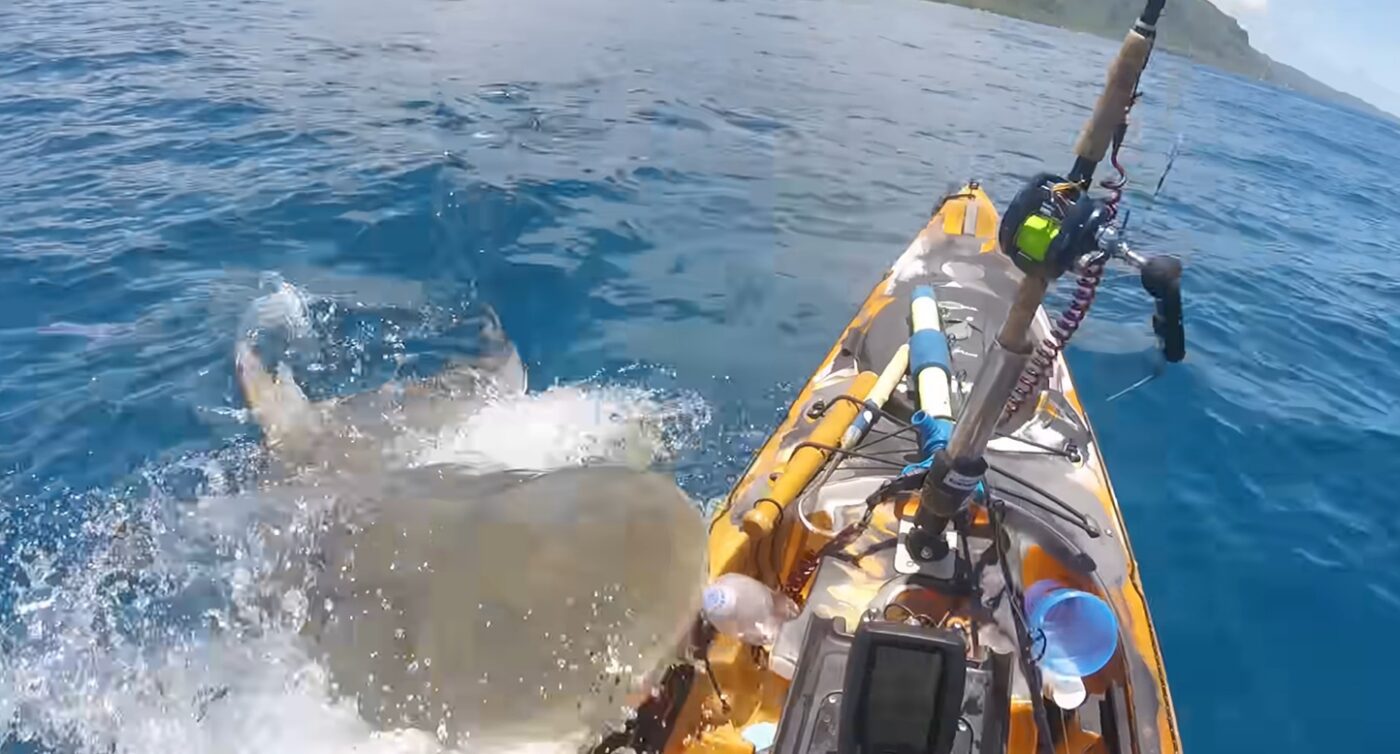
But try telling that to the guy in this video, who was spending some time off the coast of Oahu, Hawaii in his fishing kayak. The novelty of fishing out of a small boat wears off when a Tiger shark comes up that’s likely the same size.
Tiger sharks are some of the largest predatory sharks out in the ocean. They can weigh upwards of 2,000 pounds and have measured in at 14 feet long. Translation: you don’t want to go to battle with one while seated in a kayak.
The guy in this footage handled it about as well as he could have. Calm waters quickly turned into a rapid fire of curse words and kayak rocking as the Tiger shark torpedoed out of the ocean and rammed right into the man’s boat. Miraculously, the boat stayed upright, and luckily, the shark didn’t come back for seconds.
Footage below first shows the scary encounter in real time, then plays it back in slow motion. If I’m being honest, the slow motion version still seems pretty fast motion to me.
Check it out:
Why Tiger Sharks Bite Kayaks and Boats?
Encounters between tiger sharks and small watercraft like kayaks, paddleboards, and inflatable dinghies are surprisingly common, particularly in places like Hawaii and Australia.
And really, it all comes down to some simple science…
To a tiger shark looking up from the depths, the dark, oval silhouette of a kayak or paddleboard can look remarkably like a seals, dolphins, a massive sea turtle, or a large, injured marine mammal resting on the surface.
The rhythmic splashing of a kayak paddle or a swimmer’s hands mimics the erratic, struggling movements of a dying fish or injured animal, which immediately triggers the shark’s predatory instincts.
Sharks have specialized sensory organs in their snouts called the ampullae of Lorenzini, which detect the faint electrical fields given off by the muscle contractions of prey. Fish finders, trolling motors, and even the metallic hull of a boat can emit electromagnetic fields that confuse the shark, drawing it in for a closer inspection and a test bite.
Head on a swivel out there in shark-infested waters.