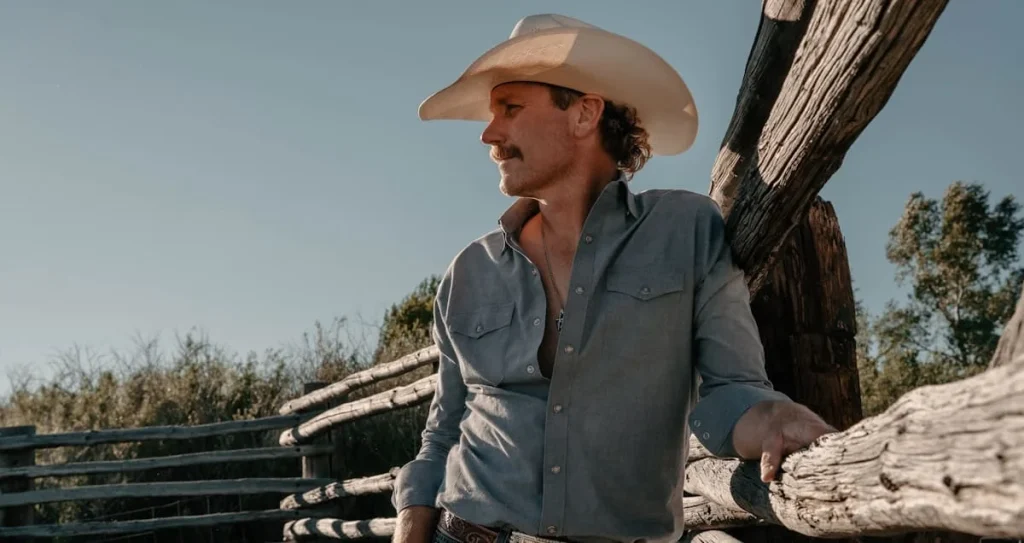
Chancey Williams sings, lives, and breathes his Western roots, and that authentic way of life takes center stage on his brand-new album, Thirsty and Blue, out now.
Released Oct. 23, the 11-track project finds the rodeo cowboy-turned-country artist carrying the stories, spirit, and sounds of traditional country and the American West into a new era, cementing his place among a select group of artists bringing an authentic, modern Western voice to country music.
“This is my eighth album, and I’ve been working on it for about a year, writing songs and picking songs on it,” Williams, who was competing in a horse event in Fort Worth, Texas, at the time of the interview, told Country Now. “I’ve always just tried to be as authentic as possible when it comes to songs I write or songs I choose.”
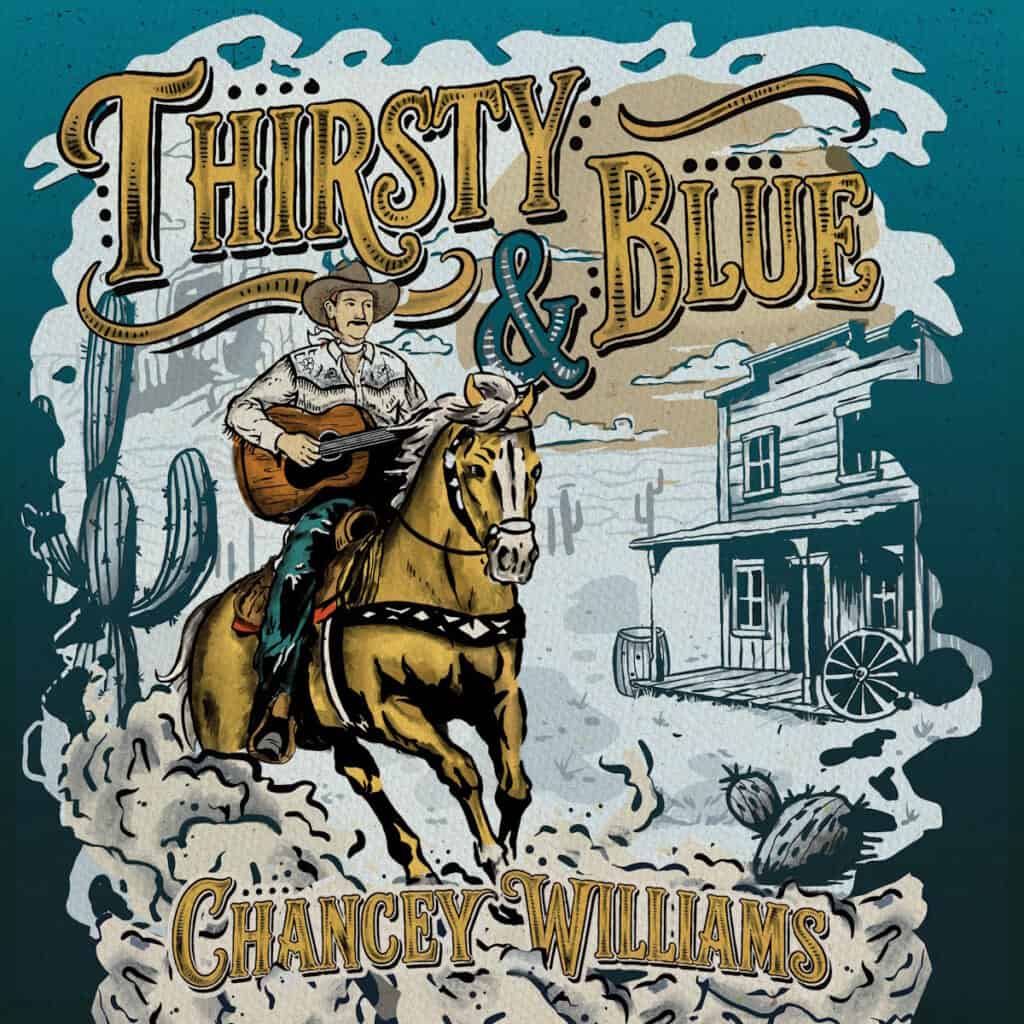
The result is a project that feels right at home, blending boot-stomping honky-tonk numbers with more heartfelt, reflective moments. Thirsty and Blue kicks off with a punch thanks to its opening track, “Saddle Up,” one of two songs Williams says has become a standout at his live shows.
“We’ve been playing ‘Saddle Up.’ We singled it, and that one’s been going over really well during my live shows,” he said. “‘It’s My Lie’ [the No. 8 track on the album] kind of has an old Gary Allan feel, and that one goes over live really well too.”
Coinciding with the album’s October release, Williams also unveiled the music video for its title track, “Thirsty and Blue,” penned by Nashville songwriters Brice Long and Shawn Camp.
“‘Thirsty and Blue’ is a type of song I’ve never really cut before,” Williams said. “It’s a throwback, kind of an old West type song. And so I was like, maybe I’ll try something new and put that on there. I heard it, and I just loved it.”
The cinematic video captures the artist’s sense of humor and charming personality while bringing the song’s tongue-in-cheek lyrics to life. Filmed at the historic Mescal Studios in Arizona, where the cult classic Tombstone, The Gambler, and other film and television productions were shot, the experience ultimately inspired Williams to name both his album and tour Thirsty and Blue.
“I didn’t really know it was going to be the title track or the tour name, but we were able to shoot a really neat video for the song at the same movie set where they shot the movie Tombstone, which is one of the greatest Westerns ever,” Williams recalled. “So we got to go down there and shoot this great music video at this awesome movie set. And the video turned out so cool. We just thought, well, what if we call the album Thirsty and Blue and we can roll it out the same day or the video the same day with the album and we’ll just call the tour Thirsty and Blue. So it all just came together because we got such a great music video and the song was kind of unique.”
For Williams, filming at such an iconic location was an experience in itself.
“It was awesome. I’ve probably seen Tombstone 200 times, and just walking on the same streets and in those buildings where Val Kilmer and Kurt Russell had been… And even back before that, Steve McQueen had filmed there. And so all these great actors had walked in the same footsteps we were filming. It was honestly one of the coolest things we’ve ever got to do.”
He continued, “We got to go down there and brought the band down on the bus. And a lot of my band and crew were in the video. My friend John Mars directed the video, so it’s filmed really sharp like a movie. 30 extras showed up all in costumes, and they brought horses and guns and stunt guys… So that’s what made it really fun.”
Williams continues to lean into his Western roots on “Town Broke,” an uptempo, lighthearted, banjo-heavy tune about two boys growing up on the outskirts of town, getting into trouble and playing in the dirt. Featuring a catchy sing-along chant and Williams’ playful sing-talking delivery, the track puts a fun spin on a familiar cowboy term.
When discussing the song’s distinctive vocal approach, Williams pointed to his musical hero, the late country entertainer Chris LeDoux, a singer-songwriter and world champion bareback rider who, like Williams, competed at Cheyenne Frontier Days and performed on its main stage.
“I always think one of the greatest guys to do that was Chris LeDoux,” Williams acknowledged. “He has that great, he could really sing, talk, and storytell in those songs. And Chris is one of my heroes. And so I would like to get better at it, if that makes sense. It’s something that I think you got to learn, and that was a fun one to try it out on.”
Written by Collin Gregory Nash, Ross Garrett Cooper, and William Clark Green, “Town Broke” also struck a personal chord with Williams.
“I’ve never really done a sing-talky song, and I heard Ross sing it one night at a writer’s round. The term town broke is a cowboy term. You want to break your horses before you bring them to town. And so it’s incorporated into these two wild little boys. It reminded me of me and my brothers when we were little coming to town. We were kind of wild. We hadn’t seen much. And so I just liked the idea of the song. But when I went to start learning it, it was the sing-talk, and I wasn’t used to doing it. But once I got into it, it was kind of fun. It reminded me of Toby Keith’s ‘Red Solo Cup.’ I would say that it was kind of hard for me to figure out how to do that. I hadn’t done that much as a singer before.”
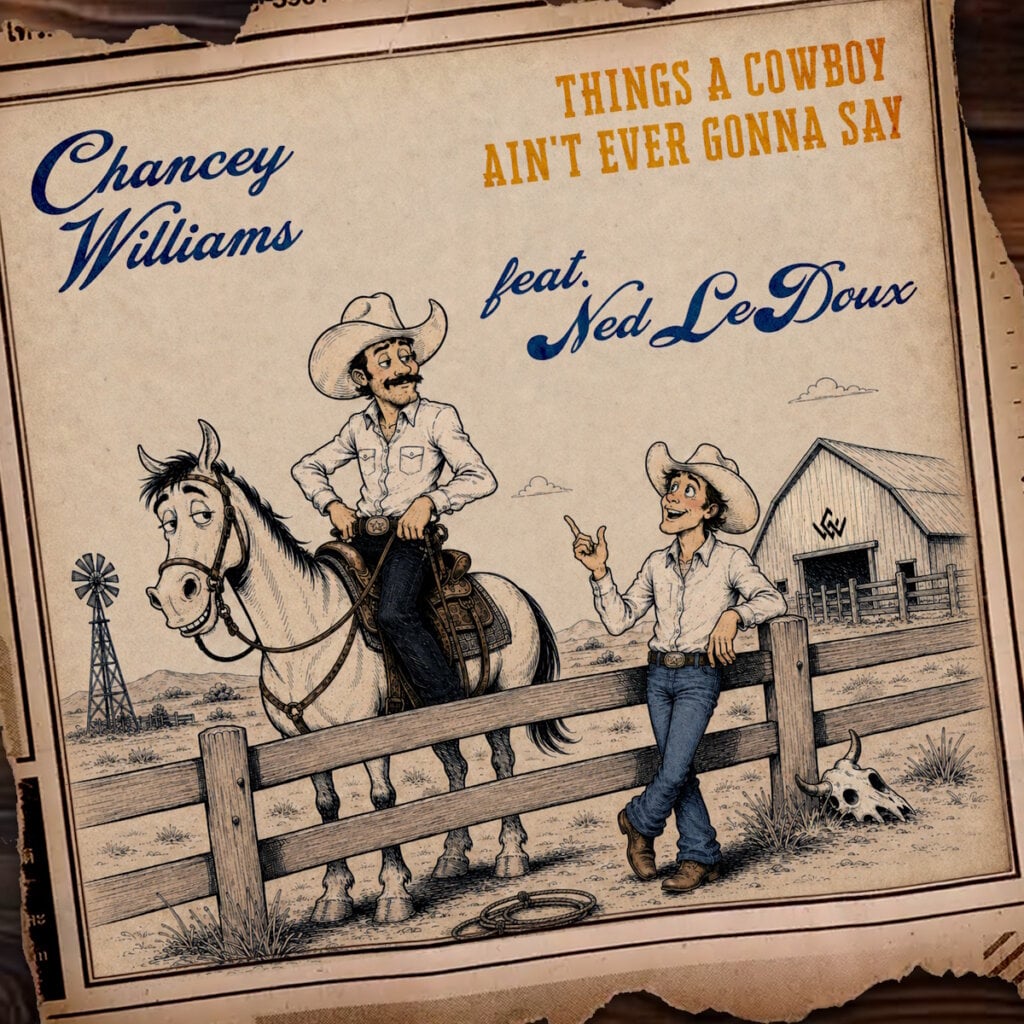
The album’s sole collaboration, “Things a Cowboy Ain’t Ever Gonna Say,” pairs Williams with his longtime friend Ned LeDoux, the son of his musical hero. Co-written by Williams and Long, the playful track takes a humorous look at things a cowboy would never say, from asking for “cream in my coffee cup” to being “okay with winning second place.”
“Once we recorded the song, I was like, ‘Man, it’d be fun to put somebody else on this, another cowboy that kind of understands that way of life.’ And I was like, ‘What if we put Ned on?’ I’ve known Ned forever,” Williams said. “My dad and his dad, Chris, were good friends growing up rodeoing. We’ve known the family forever, so it seemed like the perfect fit. And I called Ned, and he was happy to get on it, and it just felt good putting another Wyoming friend on there.”
The pair even found a creative way to make content for the collaboration despite their busy touring schedules.
“We got to shoot a bunch of fun content for it,” Williams explained. “With Ned’s touring schedule and my touring schedule this summer, I was like, there’s no way we’re going to get together. So I ordered a six-foot full-body cutout of Ned, and we called it Flat Ned. So it was just a cardboard cutout. We filmed a bunch of content. It was really fun. And yeah, Ned’s great.”
Elsewhere on the album, Williams delivers one of its most emotional moments with “Allie Girl,” a heartfelt song about a father welcoming his premature daughter into the world and eventually giving her away on her wedding day. Written by Williams, Long, and Jim Orr, the song was created specifically for Orr to share with his daughter during their father-daughter dance.
“That one’s got a great story,” Williams said of how the song came to fruition. “…Jim had called me about 10 months before his daughter was getting married and said, ‘Hey, would there be a way you could write a song about my daughter Allie that I could dance with her at the father-daughter dance?’ Summer got busy, and I didn’t get anything done. And he called me about two months before the wedding, ‘Hey, did you come up with anything?’ So I was like, ‘Oh man.’ So I called Bryce. I said, ‘Man, is there a way we could write a song for Jim’s daughter for this father-daughter dance?’ He’s like, ‘Well, just bring Jim to town. Me and Jim will just write something, and we’ll record it and get it done.’ So Jim came to town, and it was the first song Jim ever wrote.”
The song became even more meaningful when Williams learned more about Allie’s early arrival and the challenges her family faced.
“His daughter Allie was premature, and we incorporated a lot of that stuff into the lyrics about how God made her premature because he knew someday Jim would have to give her away,” Williams said. “So he just wanted to give Jim extra days with her and all those little things. And then we got to play it at the wedding, and Jim didn’t tell anybody, didn’t tell Allie… we got up there, did a father-daughter dance, got out, and we just sang it for the whole wedding. And I mean, everybody was crying. It was so special.”
The song’s impact extended beyond the wedding day. Orr also had vinyl copies made for everyone in attendance, giving guests a lasting reminder of the special moment. The family later channeled their experience into the Orr’s Hope Foundation, a Wyoming nonprofit that supports families with premature children. According to Williams, the foundation has helped more than 3,000 families.
“It’s like the Orr Hope Foundation and Jim writing a song for his daughter, and it’s special, and she was premature. It’s just really special,” he reflected.
Williams’ personal favorite song on the album is “If You Lived Here,” a stripped-down track he co-wrote with Wynn Varble. Featuring beautiful harmonies, the song captures the longing to be closer to someone you love and the difficulty of expressing those feelings.
“I guess growing up being a cowboy, cowboys don’t tend to show a lot of emotion, and I would say I’m that way too. And that song kind of talks about telling a girl that you love her without telling her you love her,” Williams explained.
He recalled how Varble helped shape the song around a familiar dating scenario: a woman who visits but always has to leave for work the next morning. The simple line, “If you lived here, you’d already be home,” offered a different way to express affection without having to say the words outright.
“It’s kind of a different way of telling a girl that you love her if you don’t really know how to show emotion. So I thought that was such a fun one to write. And Wynn’s such a great writer that I really like how that one turned out.”
With eight albums now to his name, Williams remains grounded in the same authenticity that has guided his career from the beginning. Whether selecting songs written by others or drawing from his own experiences, he says staying true to himself and his Wyoming roots remains his priority.
“I can’t fool anybody. I’m just a cowboy from Wyoming that sings music. So I always try to be genuine and authentic to our fans,” he shared. “I think fans can see right through any artist that’s maybe got a fabricated story or is trying to lie to them. Fans are smart, and so I just try to be honest with my fans and cut songs they know exactly who I am and who I represent.”
With Thirsty and Blue now out in the world, Williams has plenty more opportunities to bring its songs to the stage. His upcoming schedule includes performances during the National Finals Rodeo in Las Vegas, a Montana run, and a New Year’s Eve show at Fort Worth’s Cowtown Coliseum.
“We got a couple shows, a few shows in November, and then we roll into December, which is the National Finals Rodeo. So we’ll be out in Las Vegas for about eight days playing for the rodeo. And then New Year’s Eve, we’re playing in Fort Worth at the Cowtown Coliseum,” he said. “And then right after NFR, we go do a Montana run. Yeah, Montana run, then New Year’s. And then at the end of January, I think we’re coming back to Texas for some shows. So we got a lot of stuff coming up, which is really good. It’s super busy, but I enjoy being busy.”