
Anyone who sets foot into Yellowstone National Park is probably hoping to see some wolves in action.
They way they strategically hunt in packs with power, speed and intelligence, there’s nothing else quite like it in American wildlife… other than maybe orcas but you have to get in a boat to see them, and even then, most of the action is going on below the surface.
There’s a ton of cool things to see at Yellowstone, but for my money, wolves are the top of the list.
Wolves have played a vital role in the ecosystem of Yellowstone National Park, but their presence has been a subject of controversy, conservation, and ecological significance. Once native to the region, wolves were eradicated from Yellowstone by the early 20th century due to government predator control programs and conflicts with livestock owners.
Their removal led to dramatic changes in the park’s ecosystem, particularly in prey populations and vegetation. However, a landmark reintroduction and conservation efforts in the ’90s restored wolf populations in the park.
And now, gray wolves are the only wolf species found in Yellowstone today. They are highly adaptable and can have a variety of fur colors, including gray, black, and white. The gray wolf population in Yellowstone mainly originates from Mackenzie Valley wolves, which were reintroduced from Canada in the 1990s.
These wolves are large and well-suited to Yellowstone’s rugged terrain. Males typically weigh between 100-130 pounds, while females usually run a bit smaller, in a range from 80-110 lbs. They stand about 26-32 inches at the shoulder, and can reach snout-to-tail lengths of 6.5 feet.
They primarily prey on elk, though they also hunt bison, deer, and smaller mammals. Wolves in Yellowstone have adapted their hunting strategies based on their environment, often targeting weak or injured prey to avoid injury during the hunt. But even when targeting mature, healthy prey, they utilize their strength in numbers to hunt, often “taking turns” so to speak, when mounting an attack.
Groups of 2 to 3 wolves give chase, while the rest of the hunting party slowly catches up, until it’s time to switch lines like a hockey team, always utilizing fresh legs to chase their prey to the point of exhaustion.
Of course, this isn’t the only hunting technique, but it’s one of the most impressive to witness firsthand. It can drag out over miles.
But speaking of witness greatness firsthand, one Yellowstone guide witnessed what he called the “best wolf sighting” he’s ever had.
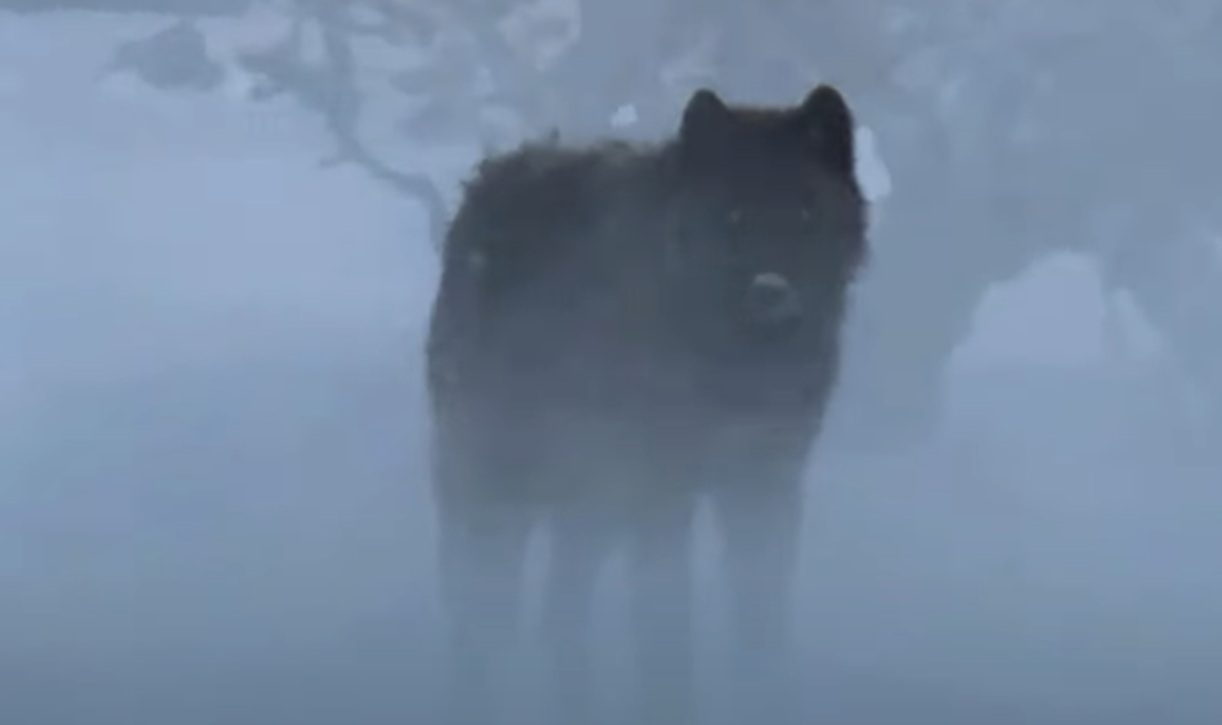
An all-black wolf, shrouded in fog from the hot springs, just staring down the camera with the rest of the pack behind….it’s like a scene from a movie. He described the once-in-a-lifetime sighting:
“Ghost wolf. This was the most quintessential Yellowstone moment I’ve ever experienced. A black wolf walking on a geothermal boardwalk while steam from a near by hot spring shrouds the rest of the pack behind. I could not believe what I was seeing!
This entire sighting was hands down the best wolf sighting I’ve ever had. Could be the best of my life! I will always hold this memory in my mind when I walk this boardwalk in the summer months.”
If this isn’t your reminder to book that trip out to the world’s first national park, I don’t know what is.
Black wolves are actually quite common in Yellowstone, despite the “gray wolf” name. Biological research has revealed that this black coloration is actually the result of a genetic mutation introduced by domestic dogs mating with wild wolves many years ago.
Interestingly, scientists have found that this specific gene also provides an immunological boost, helping black wolves survive outbreaks of diseases like canine distemper at much higher rates than their gray-coated pack mates.
More on Yellowstone’s Wolves
By the 1920s, gray wolves had been completely eradicated from Yellowstone due to aggressive, government-backed predator control programs.
Without their primary predator, the park’s elk population exploded, leading to severe overgrazing that decimated the ecosystem.
In 1995 and 1996, wildlife biologists captured a total of 31 wolves from western Canada and released them into the park. The population quickly established itself, which sparked a better wildlife balance in the park.
The constant threat of wolves forced elk to stay on the move rather than lounging by rivers, which allowed overgrazed aspens and willows to recover. This sudden burst of vegetation subsequently brought back beavers, songbirds, and created healthier, more stable riverbanks.
Wolves Today
The gray wolf population living entirely within Yellowstone National Park typically fluctuates between 90 and 125 individuals spread across roughly 10 packs.
This number naturally rises in the spring when new litters of pups are born and dips through the winter due to natural mortality.
The park’s population is largely self-regulating at this point, with the primary factors controlling their numbers being prey availability (mainly elk), outbreaks of diseases like canine distemper or mange, and fatal territorial disputes between rival packs.